

“Zoom Got It Done” is the tagline for the company’s new Zoom Ahead campaign, with the focus being how Zoom’s AI-first capabilities take conversations to completion. This one features Kate McKinnon and builds on their “I Use Zoom!” spot with Bowen Yang that kicked off this consumer-friendly campaign late last year.
For the record, I’m not a fan of their comedic approach here, but the ads hold your attention, and it’s great seeing SNL favorites playing over-the-top corporate tropes. Am just not so sure the messaging gets it done.
Wearing my Marketing hat, I’ll note that B2C marketing campaigns from tech companies are really hard to do well, especially when the audience is not the economic buyer. The Zoom ads are aimed at workers – end users – while the buyers – IT and CEOs – are caricatured as the worker’s worst nightmare.
This is a topic I’d love to explore further, but I need to stay on script and tie their Got It Done tagline to the main topic, namely my review of the recent Zoomtopia event. While the event is mainly for customers and partners, I was part of the small cohort of analysts who attended as well.
Since Zoomtopia caters primarily to those economic buyers, it wasn’t surprising that the Got It Done message was the opening theme for the event, capped by a local choir that went full gospel to celebrate the uplifting power of AI to get work done and relieve us of so many tedious tasks that undermine our productivity. Am not sure if everyday workers get that euphoria when using Zoom, but that’s the aspiration – nothing wrong with that, amen.

Choir singing the praises of ‘Got It Done’
Jon Arnold
More importantly, I think Zoom is trying to communicate how AI is transforming their platform into something bigger than video calls and meetings. On that count, I think Zoomtopia succeeded, perhaps in ways that most people don’t realize. In that context (pun intended), I’ve distilled my takeaways into three big ideas.
This was the big story at the event, so let’s start there.
I’m never the first analyst to post about industry events, but I’m going with flow here, as this was the lede most of my peers went with for their write-ups. What I haven’t seen so far, though, is connecting the dots to the last time most of our group was at a Zoom event. That would be Perspectives, their analyst-only event, and back in April we got the deep dive on their go-to-market vision, “from conversation to completion”.
The overall reception was positive, and it marked a new chapter in Zoom’s evolution to align more closely with AI’s transformative potential and get beyond being a meetings platform. Building on the premise that all interactions start with some form of conversation, AI does all the hard work of taking those conversational inputs, identifying next-best actions and closing with intelligent task completion.
At Zoomtopia 2026, the big story was Unified Context Layer, which takes that vision one step further. The missing piece was context, where AI is now better able to understand intent, sentiment, urgency, etc., and connect all that to memory across the entire lifecycle of an interaction. Humans simply cannot do this at scale and in real time, so this is where the AI story becomes next level.
On a more basic level, this is no longer about human-to-human communication, the foundation upon which all UCaaS platforms are built. Communication remains the cornerstone for how work gets done, but now it’s just as much about P2P as it is about P2A, A2P, A2A and B2B. Translation – people need to communicate among themselves, but increasingly it’s also agent-to-agent, bot-to-bot and everything in between. Getting context right is more challenging when AI agents are involved, and that point will tie into my second big theme.
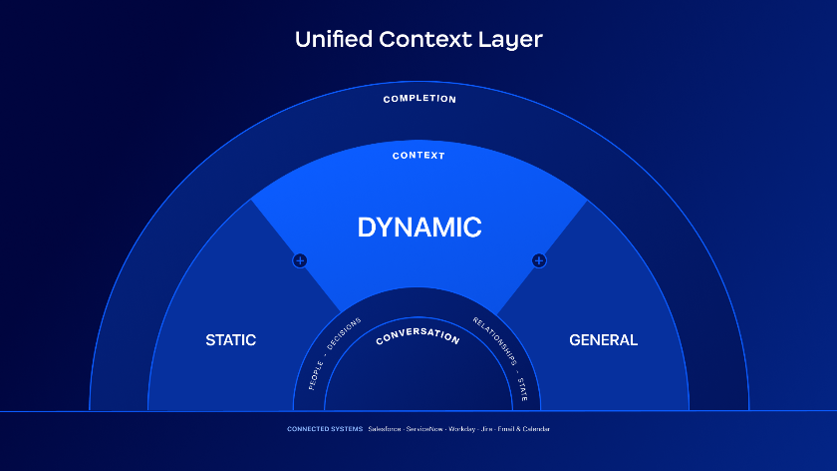
Zoom’s new Unified Context Layer
Zoom
To make all this work, the vision needs to be broader, so now it’s “conversation to context to completion”, and that’s what the Unified Context Layer brings to the Zoom platform. You can read more about it here, and I’ll just add some key points to show why the context piece is so important.

Zoom Ahead campaign featuring actress and comedian Kate McKinnon.
Zoom
I may be going out on a limb here, but Anthropic was barely mentioned at Zoomtopia, and it seems to me this is driving a lot of Zoom’s evolution, perhaps more than we realize.
If you don’t know, Zoom took a small stake in the company in 2025, and has since added to its position. Financially, it’s been a huge windfall for Zoom, but that’s really beside the point. Zoom and all the other cloud players in their orbit cannot afford to not be close to all the AI players in Anthropic’s orbit – that’s just how Big Tech works.
For Zoom in particular, this is about helping transform the company into an AI-first platform, and what better way to do that than by leveraging their small stake with one of the top three players creating the AI economy? In that context – there’s that word again – their “system of action” vision makes more sense. Yes, human workers will use these tools to take conversations to completion, but longer term, this system will be about AI taking the action.
I’ll call this the “Anthropic Effect” because Claude is now deeply embedded in everything Zoom touches – collaboration and meetings with UCaaS, customer interactions with CCaaS and more recently, ZRA for sales automation – Zoom Revenue Accelerator. All of these data flows cross Zoom’s platform, and this is where AI agents need to be to tap into the data that takes conversations to completion.
Memories can be short, but AI Companion was a cornerstone for how workers engaged with the Zoom platform. Yes, all platforms evolve, and AI Companion was quietly retired, replaced – augmented, really – by ZoomMate. AI Companion hasn’t really gone away; it’s just been subsumed by something bigger and more agentic. Perhaps to make room for Claude, or at least get hooks into what their system of action is trying to do.
On a technology level, this is perfectly reasonable. Zoom has actually been at the forefront of innovation in our space, and they have succeeded at just about everything they’ve taken on internally. However, I think it’s fair to say that even Zoom cannot replicate what Anthropic, OpenAI, Meta, et al have been doing with AI.
Depending on how you look at things, I think the business rationale for riding with Anthropic is even stronger. Consider the chart below, from App Economy Insights. They publish a newsletter that breaks down how tech companies make money, and Anthropic’s revenues are up 45-fold over the last six quarters.
Of greater interest, as their newsletter reports, Anthropic has almost 12,000 enterprise customers spending $100k+ annually – exactly the kind of customers Zoom covets. To whatever extent these customers rely on Claude, this sure dovetails nicely with Zoom’s value proposition. Going from conversation to context to completion at scale requires a lot of AI horsepower, and the more tightly Claude integrates with ZoomMate, the more successful both companies will be.
Of course, Claude could fall out of favor, and all of this will be moot, and every other cloud platform player is partnering with Anthropic, so nothing is for sure. That aside, though, this looks like a good way for Zoom to build a moat they can defend, especially as AI gains trust and is used to automate more workflows and tasks. That makes for a good growth story to become an AI-first system of action that truly takes them out of the UCaaS milieu that is going sideways at best.
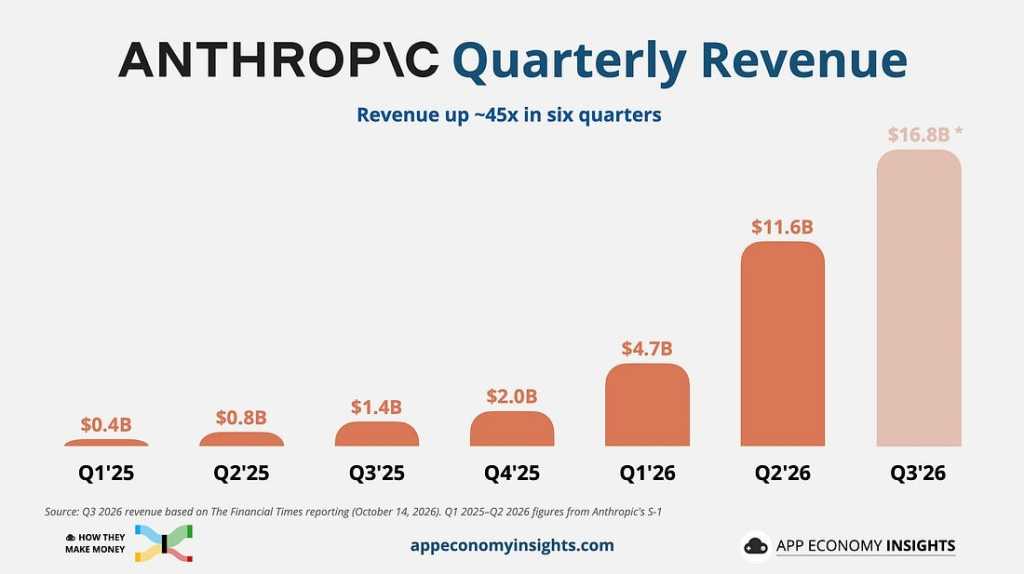
Anthropic’s revenue growth
App Economy Insights
Finally, I wanted to note this focus, as it says a lot about how Zoom wants to be positioned, and how they want to be perceived by enterprise IT leaders.
This is a core piece of the story in terms of Zoom becoming an AI-first platform and truly evolving beyond video calls, meetings and UCaaS. Their new management controls are coming soon, but this signals where and how Zoom intends to play.
With Anthropic now in their DNA, these are the capabilities Zoom will need to become a centralized system of action for enterprises. Not siloed for workplace productivity or in the contact center, but to be the hub for all communications flows.
Again, this is no longer a UCaaS story – one could argue that Teams holds court there, along with other leading UCaaS players – and Zoom is looking beyond this and wants to be positioned on a higher, more strategic plane.
In this – yes, context – the Zoomtopia updates were about the things that IT really cares about when managing these do-it-all platforms. This is about enterprise-wide policy and governance, not updating permissions to edit transcripts, configuring new endpoints for meeting rooms or updating CRM integrations.
These are the bigger picture controls that IT needs to be comfortable and confident that Zoom can really be this system of action for the entire organization. To illustrate, here are three examples for how Zoom intends to earn their trust.
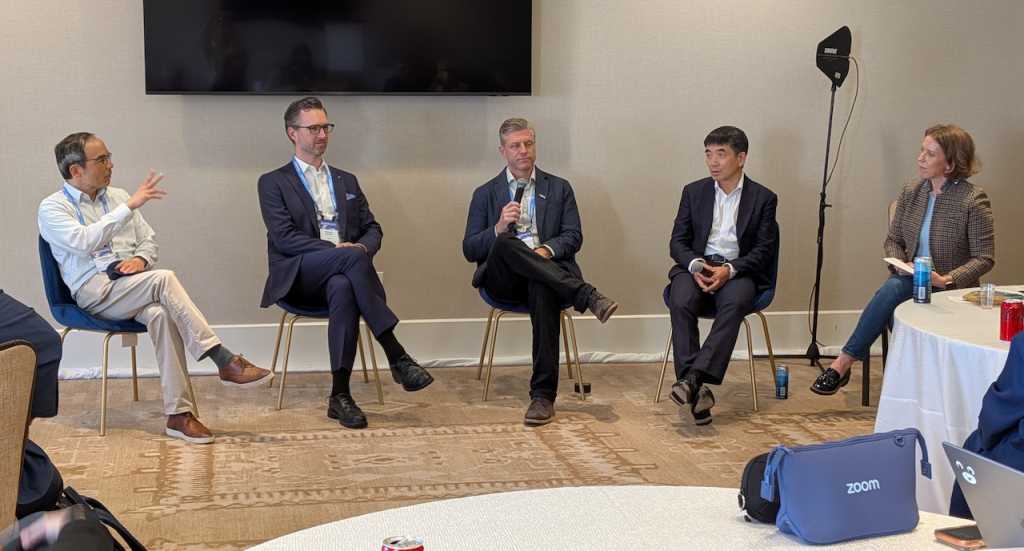
Zoom executive Q&A with analysts
Jon Arnold
During the executive Q&A with analysts, Eric Yuan was asked where Zoom would like to be in the future, and I think his three-word response sums up everything I’ve been trying say here. He envisions Zoom as a “work operating system”. Not a UCaaS platform, not a meetings app, but something bigger, and more of a hub that enterprises can organize workflows around.
Conversations to context to completion is the path for getting there, but this puts them up against hyperscalers who are all-in with AI, and not terribly interested in the communications layer that got Zoom this far in relatively little time.
Is Zoom ready for this? Will their customers be ready to view Zoom this way? With much of this data residing with third-party apps, who will ultimately control all the data needed to be a work operating system? What role will the hyperscalers and AI majors play? How will their working relationship with Anthropic evolve to support this vision?
These are just a few leading questions to consider following Zoomtopia. Prediction markets aside, I’m more inclined to bet on Zoom than against Zoom, as their track record for making moves has been pretty good.
The management team has both vision and confidence – they know what they have, where they’ve been and where they need to be going – and I’ll try to answer those what’s-next questions as things progress. As with everything AI, they will progress, and Zoom just might get it done; in which case Kate McKinnon’s Zoom Rage will turn up to 11. Can’t wait to see that!


